

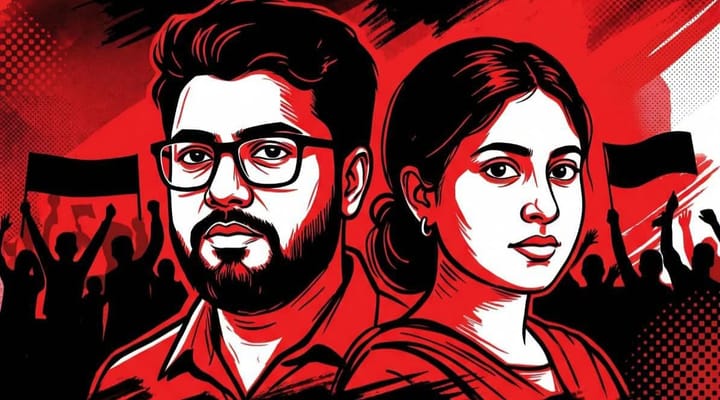
Lihon Prime and Tithi are both well-known science thinkers and anti-establishment writers in Bangladesh. Widely known online as "Lihon Prime," the writer’s real name is Anwar Hossain Parvez (32), and his wife is Mahin Istiaz Jahan Tithi (25). Since getting married, they had been living in a flat at Garden City in Feni town, Bangladesh. Alongside regularly writing and creating video content on social media about evolution, science, psychology, women's freedom, and rationalism, the couple also wrote, edited, and translated books. In addition to science and society, they regularly wrote about religion, traditional beliefs, and atheism. Because of these writings, they gained a massive online following—at least 250,000 users follow Lihon on Facebook alone. However, they frequently faced controversy due to their critical remarks on religious matters.
While Islamist fundamentalist violence against freethinkers appeared to be relatively isolated incidents before the political shift of August 5, 2024, fundamentalism and "mob terrorism" have since increased at an alarming rate in Bangladesh. From late 2024 until now, attacks, vandalism, and arson targeting traditional shrines (mazars) and Sufi lodges (darbar sharifs) have been occurring continuously across the country. Furthermore, in the name of "mob justice" or the "Tawhidi Janata" (religious mobs), minorities, atheists, secularists, and freethinkers have been killed one after another in mob violence. Sometimes a simple Facebook post, sometimes a trivial argument at a tea stall, and at other times a casual conversation with a colleague has triggered these attacks.
According to a report by the Bangladesh Hindu Buddhist Christian Unity Council, at least 522 incidents of communal violence against minority communities occurred in 2025. Additionally, a report by the Human Rights Congress for Bangladesh Minorities (HRCBM) covering the first six months of 2026 (January–June) documented over a hundred incidents of vandalism of religious institutions, land grabbing, and violence.
The accounts of several notable incidents over the past two years are deeply horrifying:
- September 2024: In Khulna, an angry mob gathered in the very presence of law enforcement agencies and attempted to beat a young man named Utsab Mandal to death over allegations of blasphemy.
- November 2024: During repeated attacks and clashes at "Murshidpur Darbar Sharif" (Khaja Baba's shrine) in the Lachmanpur area of Sherpur Sadar Upazila, the shrine's caretaker, Hafez Uddin, was killed.
- September 2025: On September 5, a ferocious attack was carried out on the shrine of Nurul Haque alias Nural Pagla in Goalanda, Rajbari, where his body was exhumed from the grave and burned; one person named Russel Mollah was killed and over fifty others were injured in the clashes.
- December 2025: In Bhaluka, Mymensingh, a garment worker named Dipu Chandra was dragged out of his factory and brutally beaten to death over allegations of insulting religion.
- April 2026: On April 11, over two hundred people attacked the shrine of Pir Shamim Jahangir alias Abdur Rahman in Philipnagar Union of Daulatpur Upazila, Kushtia, over allegations of desecrating the Quran. The attackers dragged him out of his room, hacked and beat him with sharp weapons, and threw him down from the second floor. He later died while undergoing treatment at the Daulatpur Upazila Health Complex.
- October 2026: In Debhata, Satkhira, a crowd was gathered via Facebook Live after allegations of blasphemy were raised over an audio recording of a conversation involving a science-minded man named Wahiduzzaman Shamim. Later, the mob attacked the Upazila Health Complex, snatched him away, and beat him to death in multiple rounds.
During this period, several other fatalities occurred across the country in violence targeting minorities and shrines over blasphemy allegations. According to data from the human rights organization Ain o Salish Kendra (ASK), mob terrorism claimed 128 lives in 2024, 197 in 2025, and 171 up to September 2026. Meanwhile, according to the Manabadhikar Shongskriti Foundation (MSF), a total of 868 people lost their lives in all forms of mob violence over the roughly 34-month period from 2024 to October 2026. Secular, atheist, leftist, science-minded, anti-establishment, and anarcho-syndicalist circles in Bangladesh are deeply concerned by these events. Despite witnessing one atrocity after another on social media newsfeeds, it has unfortunately not been possible to take any effective measures to prevent them.
Lihon Prime and his wife Tithi are the latest victims in this ongoing pattern. Recently, in a post from his personal Facebook account, Lihon mentioned that the amount of bacteria in human beards is higher than that in dog fur. To support this, he attached citations from international peer-reviewed journals. However, ignoring the scientific explanation from the academic journals, devout locals viewed the comparison between dog fur and the religious practice of keeping a beard (Sunnah) as "hurting religious sentiments."
As a result, around 9:15 PM on Tuesday, November 17, 2026, an agitated mob gathered downstairs at Garden City in Feni town and began protesting. Upon receiving the news, police from Feni Model Police Station arrived at the scene and detained Parvez and his wife Tithi from their 16th-floor apartment. While they were being put into the police van, the agitated mob assaulted Parvez and threw bricks and eggs at the vehicle. At least four people, including two police officers, were injured, and the police vehicle was damaged. Upon learning of the incident, I spoke directly with the Officer-in-Charge (OC) of Feni Model Police Station, and the police confirmed the authenticity of the events.
In connection with this incident, Sub-Inspector (SI) Md. Israfil of Feni Model Police Station filed a case as the plaintiff against Parvez and Tithi under the Cyber Security Act and relevant sections of the Penal Code (on charges of hurting religious sentiments). On Wednesday, November 18, the couple was sent to Ranirhat jail through the court.
Case Details, Applicable Laws & Punishments, and Our Next Steps
1. Preliminary Case Information
- Police Station: Feni Model Police Station
- Case Number: 20
- G.R. (General Register) Number: FGR 731/26
2. Applicable Laws and Sections
- Laws: Cyber Security Act, 2026 along with the Penal Code, 1860.
- Applicable Sections: Section 26 of the Cyber Security Act, 2026, and Sections 295(A) and 505(A) of the Penal Code, 1860.
If convicted under these three sections, what the maximum and minimum punishments for Prime Lihon and his wife could be is analyzed below under the criminal laws of Bangladesh (particularly the Code of Criminal Procedure and the General Clauses Act):
1. Summary of Punishments (By Section)
| Law and Section | Maximum Imprisonment | Monetary Penalty (Fine) |
|---|---|---|
| Cyber Security Act, 2026 (Section 26) | Up to 2 years | Up to BDT 5 lakh (or both) |
| Penal Code, 1860 — Section 295(A) | Up to 2 years | Fine as determined by the court (or both) |
| Penal Code, 1860 — Section 505(A) | Up to 7 years | Fine as determined by the court (or both) |
2. How Sentences Across Multiple Sections Will Take Effect Together?
Under the laws of Bangladesh, when sentences are imposed simultaneously under multiple sections, they generally take effect in one of two ways (under Section 35 of the Code of Criminal Procedure):
- Concurrently: Courts in Bangladesh usually order sentences under multiple sections to be served concurrently. If the court passes this order, serving the sentence carrying the highest punishment among all sections will cover the others within that period. In this case, the maximum imprisonment would be 7 years (the maximum sentence under Section 505(A)).
- Consecutively: If, considering the gravity of the offense, the judge explicitly states in the judgment that one sentence will begin after another ends, the sentences for all sections will be added together. In that case, theoretically the maximum imprisonment would stand at: 2 + 2 + 7 = 11 years.
3. Important Legal Consideration (Double Jeopardy)
There is a specific legal aspect to note here:
- No double punishment for the same offense under two laws (General Clauses Act, Section 26): Both Section 26 of the Cyber Security Act and Section 295(A) of the Penal Code relate to "hurting religious sentiments." Under the law of Bangladesh, if the same act or offense is punishable under two different laws, the accused may be prosecuted under both, but cannot be punished twice for the same offense. That is, if the court imposes a 2-year sentence under Section 26 of the Cyber Security Act for hurting religious sentiments, there is no scope to impose a separate 2-year sentence under Section 295(A) of the Penal Code for the exact same act. In that scenario, even the maximum consecutive sentence would drop from 11 years to 9 years (2 + 7 years).
4. Fines and Practical Application
- Monetary Penalty: Even when prison terms run concurrently, fines are calculated separately. The court may impose up to BDT 5 lakh under the Cyber Security Act and additional fines under the Penal Code sections. Failure to pay the fine may result in additional imprisonment (generally up to one-fourth of the substantive sentence).
- Maximum vs. Actual Sentence: The 2 years or 7 years mentioned in the law represent the maximum punishment limits. Since these sections do not prescribe a "minimum punishment," the judge—taking into account the gravity of the offense, age, or whether there is any prior criminal record—may award a sentence well below the maximum (such as a few months or 1–2 years) or release with only a fine.
(Note: This is a general analysis based on prevailing statutory provisions; the final verdict depends on the FIR/charge sheet, witness testimony, evidence, and judicial discretion.)
It had been hoped that during this critical moment, progressive individuals in Bangladesh would actively stand beside these two victims. Unfortunately, despite being present at the court the entire time, no supportive figures were seen there. However, many leftist activists and independent atheists are writing in their defense online. Under these circumstances, the "Bangladesh Workers' Association" (Bangladesh Sramik Samiti) has taken it upon itself as a moral responsibility to carry on the legal battle for the couple's release. We have already sought solidarity from the "Anarcho-Syndicalist Federation" (ASF), the Australian section of the International Workers' Association (IWA). They have consistently played a vital role in various struggles across South Asia by issuing statements and providing financial and moral support. This time too, the ASF has taken responsibility for covering all expenses of the couple's legal battle, and we have already appointed a lawyer. We will regularly publish updates on the progress of the case and the overall situation.
Kazi Tanvir Hossain
Writer and Journalist
Feni, Bangladesh